National Patient Safety Goals para sa Nursing Care Centers
Key Points
- Ina-update ng Joint Commission ang National Patient Safety Goals taun-taon gamit ang kasalukuyang safety data.
- Dapat ilapat ng nurses ang goals na partikular sa kanilang practice setting, kabilang ang nursing care centers.
- Core nursing-care-center priorities ang identification accuracy, medication safety, infection prevention, falls prevention, at pressure-injury prevention.
- Nakasalalay ang goal implementation sa pare-parehong workflows, documentation, at patient/caregiver teaching.
- Setting-specific ang goal sets sa maraming care environments, kaya dapat i-validate ng teams taun-taon ang active version para sa kanilang service line.
Pathophysiology
Ang NPSG ay systems-safety framework na tumutok sa high-frequency at high-harm failure points sa care delivery. Sa nursing care centers, madalas na nagkakumpol ang harm sa identification mistakes, medication communication gaps, infections, falls, at skin breakdown.
Ang paggamit ng standardized goal-based practices ay nagpapababa ng preventable injury risk at nagpapahusay ng continuity sa handoffs, transfers, at outpatient follow-up.
Classification
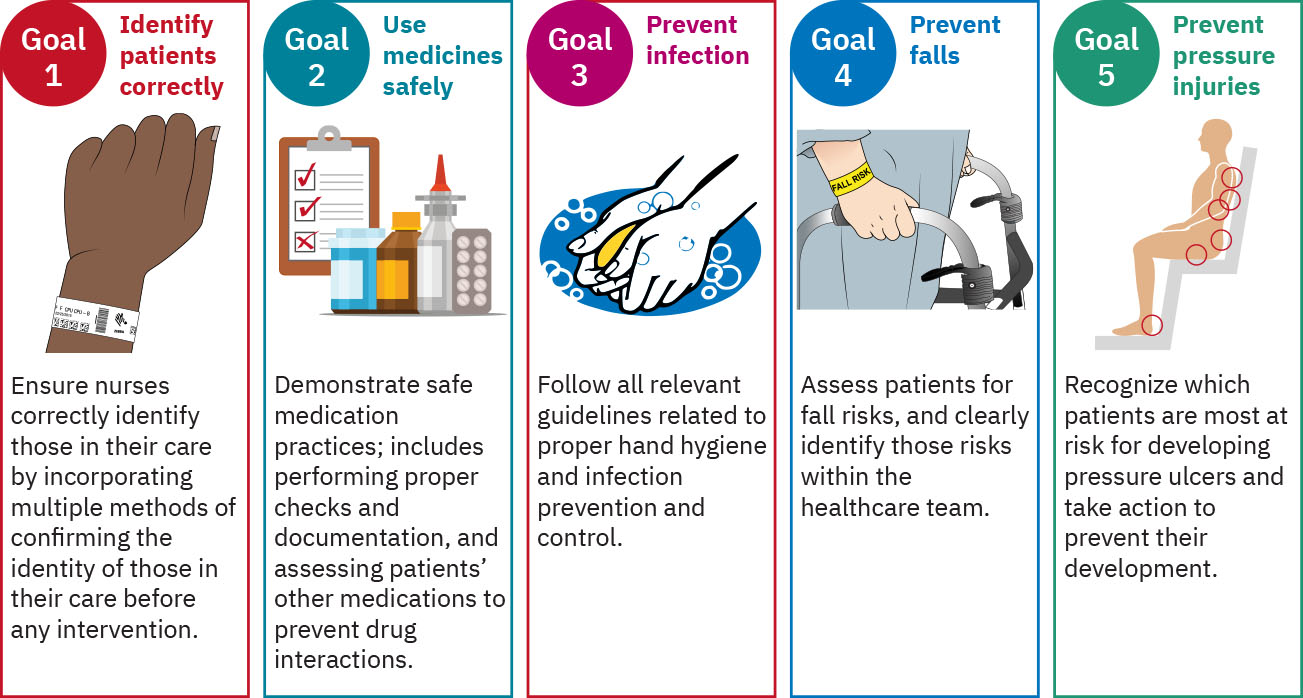 Illustration reference: OpenStax Fundamentals of Nursing Ch.9.1.
- Identify residents correctly: Gumamit ng hindi bababa sa dalawang identifiers bago ang care, medication, at treatment.
- Two-identifier confirmation options: Verbal identifiers (name/date of birth) kasama ang second-source verification (wristband scan/chart/MAR photo/staff o family confirmation kapag hindi makapag-self-identify ang pasyente).
- Use medicines safely: Ipatupad ang high-risk medication safeguards at i-reconcile ang medications sa bawat transition.
- Prevent infection: Sundin ang CDC/WHO hand-hygiene guidance at i-track ang improvement.
- Prevent falls: Tukuyin ang high-risk residents at ipatupad ang fall precautions.
- Prevent pressure injuries: Tukuyin ang at-risk residents, ipatupad ang prevention bundles, at madalas na muling tasahin ang balat.
Nursing Assessment
NCLEX Focus
Sinusubok ng NPSG questions kung kaya ng nurse i-map ang safety event sa tamang goal at agarang prevention action.
- I-verify ang two-identifier compliance bago ang interventions.
- Kung hindi kayang sabihin ng pasyente ang identifiers, gumamit ng policy-approved alternate verification (halimbawa wristband scan at independent staff/family confirmation).
- Tayahin ang anticoagulant at polypharmacy risks sa medication workflows.
- Tayahin ang medication-list accuracy sa admission, transfer, at return visits.
- Tayahin ang hand-hygiene adherence at infection-risk patterns.
- Tayahin ang fall risk factors (halimbawa panghihina, pagkahilo, sedating medications).
- Tayahin ang pressure-injury risk at kasalukuyang skin integrity status.
- Tayahin ang bedside safety-readiness details na pumipigil sa agarang harm (halimbawa allergy-band visibility kung indicated, isolation-precaution signage/equipment, at call-light access na may bed-low/locked setup).
Nursing Interventions
- Ipatupad ang two-identifier verification para sa lahat ng medications at treatments.
- Gumamit ng medication reconciliation workflows at bigyan ang pasyente ng written medication lists.
- Turuan ang residents/families na magdala ng updated medication list sa bawat provider visit.
- Ilapat ang CDC/WHO hand-hygiene standards at unit-level adherence goals.
- Ipatupad ang individualized fall precautions para sa high-risk residents.
- Gumamit ng repeatable safety sweep workflow sa care rounds (identity/allergy check, bed position at side-rail strategy, call-light reachability, at line/device hazard check).
- Ipatupad ang pressure-injury prevention actions at scheduled reassessment ayon sa protocol.
- I-review ang annual NPSG updates at iayon ang unit policy/practice dito.
Goal-Drift Risk
Kapag hindi naisasama sa araw-araw na practice ang annual goal updates, maaaring maulit ang preventable harm patterns.
Pharmacology
Kasama sa medication-related NPSG focus ang anticoagulant safety, complete medication reconciliation, at malinaw na patient-facing medication instructions sa transitions.
Clinical Judgment Application
Clinical Scenario
Isang long-term-care resident ang na-readmit matapos ang dizziness at fall; hindi tugma ang medication list sa naunang discharge paperwork.
- Recognize Cues: Fall event kasama ang medication-list discrepancy.
- Analyze Cues: Malamang na may NPSG gaps sa falls prevention at medication safety.
- Prioritize Hypotheses: Nangangailangan ng agarang risk reduction sa pamamagitan ng reconciliation at pag-update ng fall-prevention.
- Generate Solutions: Kumpletuhin ang med reconciliation, i-adjust ang precautions, at palakasin ang two-identifier process.
- Take Action: Ipatupad ang revised plan at turuan ang resident/family.
- Evaluate Outcomes: Walang recurrent fall at nananatiling tama ang medication list sa transitions.
Related Concepts
- organizational culture: patient-centered, collaborative, at safety frameworks - System culture na kailangan upang mapanatili ang NPSG implementation.
- medication rights at three-checkpoint verification - Suporta sa identification at medication-check workflow.
- medication regimen management - Reconciliation at reliability ng patient medication lists.
- fall prevention - Core interventions para sa high-risk residents.
- pressure-injury staging at risk assessment - Prevention at surveillance na nakaayon sa NPSG skin goals.
Self-Check
- Aling NPSG actions ang mandatory bago ang medication administration sa nursing care centers?
- Bakit sentral ang medication reconciliation sa NPSG medication-safety performance?
- Paano nag-iinteract ang fall at pressure-injury goals sa frail residents?