Benign Prostatic Hyperplasia
Mahahalagang Punto
- Ang BPH ang pinakakaraniwang prostate disorder — nakaaapekto sa >50% ng men na edad 51-60 years at ~70% ng men na higit sa 60 years; benign, age-related na paglaki ng prostate.
- Mechanism: Ang pinalaking prostate ay dumidiin sa urethra → lower urinary tract symptoms (LUTS): urinary hesitancy, weak stream, frequency, nocturia, incomplete emptying.
- Diagnostics: Symptom scoring kasama ang PSA, DRE, at piling urologic studies (urodynamic flow testing, voiding cystourethrogram, cystoscopy).
- Pharmacotherapy: Ang a1-adrenergic antagonists (tamsulosin, terazosin) ay nagpaparelaks ng smooth muscle → nagpapabuti ng flow; ang 5-a-reductase inhibitors (finasteride) ay nagpapaliit ng prostate.
- Surgical: TURP (transurethral resection of the prostate) — pinakakaraniwan; ang post-op nursing priority ay continuous bladder irrigation (CBI) monitoring.
- Key nursing concern: Nagdudulot ang a1-blockers ng orthostatic hypotension — turuan ang pasyente na dahan-dahang tumayo.
Patopisyolohiya
Ang prostate gland ay nasa ilalim mismo ng urinary bladder na nakapalibot sa proximal urethra. Sa pagtanda, dumaraan ang gland sa benign enlargement (hyperplasia). Habang lumalaki ang prostate, kinokompress nito ang urethra, humahadlang sa urinary outflow at nagdudulot ng:
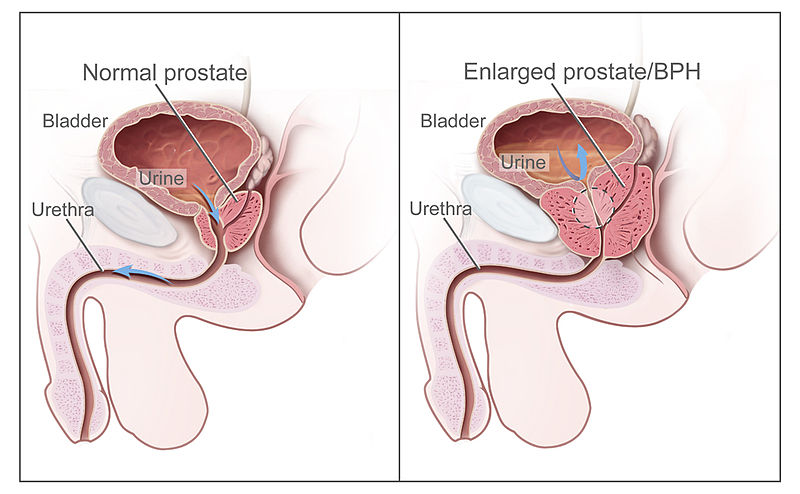 Sanggunian ng ilustrasyon: OpenRN Nursing Health Promotion Ch.8.9.
- Incomplete bladder emptying
- Bladder overdistension at detrusor muscle dysfunction
- Mas mataas na panganib ng UTI, urinary retention, at hydronephrosis kapag hindi nagamot
Ang BPH ay hindi cancerous — hindi nito pinapataas ang panganib ng prostate cancer; gayunman, maaaring magsabay ang BPH at prostate cancer sa iisang pasyente.
Clinical Manifestations (LUTS)
| Symptom | Description |
|---|---|
| Urinary hesitancy | Hirap simulan ang urinary stream |
| Weak or intermittent stream | Paumpisa-hinto ang daloy; may dribbling sa dulo ng stream |
| Nocturia | Madalas na pag-ihi sa gabi |
| Urinary frequency | Mas madalas na pag-ihi, kadalasan kaunting dami |
| Incomplete emptying | Pakiramdam na may natitirang ihi pagkatapos umihi |
| Urinary urgency | Biglaang malakas na pagnanais umihi |
| Recurrent UTI/kidney stones | Mula sa urinary stasis at retention |
| Hematuria | Late sign ng prostate cancer (hindi karaniwan sa BPH lamang) |
Assessment at Diagnostics
- Digital Rectal Examination (DRE): Ipinapasok ng provider ang lubricated finger sa rectum upang tasahin ang laki at texture ng prostate
- BPH: smooth, uniformly enlarged prostate
- Prostate cancer: hard nodule sa prostate
- PSA (Prostate-Specific Antigen): Blood test — tumataas sa BPH o prostate cancer; screening guidelines: test bawat 2 years kung PSA <2.5 ng/mL; taun-taon kung PSA >2.5 ng/mL
- International Prostate Symptom Score (I-PSS): Standardized questionnaire para sa pagtasa ng LUTS severity
- Urinalysis: Nagsi-screen para sa UTI, hematuria, kidney stones (karaniwang komplikasyon ng BPH)
- Post-void residual (PVR) measurement: Tinutukoy ang dami ng ihing natitira pagkatapos umihi (>100 mL ay nagpapahiwatig ng makabuluhang retention)
- Urodynamic flow testing: Tinatasa ang bladder/sphincter/urethral storage at release performance, kabilang ang involuntary contraction patterns
- Voiding cystourethrogram (VCUG): Fluoroscopy na may contrast habang filling at voiding upang suriin ang urinary-tract anatomy at direksyon ng urine flow
- Cystoscopy: Direktang urologic visualization ng urethral/prostatic obstruction
Pharmacological Treatment
| Drug Class | Examples | Mechanism | Key Adverse Effects |
|---|---|---|---|
| a1-Adrenergic antagonists | Tamsulosin, Terazosin, Doxazosin, Alfuzosin | Nirere-relax ang smooth muscle sa bladder neck at prostate → pinabuting urine flow | orthostatic-hypotension(orthostatic hypotension), pagkahilo, sakit ng ulo, syncope |
| 5-alpha-reductase-inhibitors(5-alpha-reductase inhibitors) | Finasteride, Dutasteride | Hinaharang ang conversion ng testosterone tungo sa dihydrotestosterone (DHT) → nagpapaliit ng prostate sa loob ng buwan; madalas nasa humigit-kumulang 6 months ang maximal response na may PSA decline na humigit-kumulang 50% | Nabawasang libido, erectile-dysfunction(erectile dysfunction), nabawasang ejaculatory volume, gynecomastia |
| Combination and adjunct therapy | Finasteride + doxazosin, dutasteride + tamsulosin, alpha-blocker + antimuscarinic | Pinapabuti ang symptom burden/flow sa piling clients; maaaring gamitin ang antimuscarinics para sa overactive bladder symptoms | I-monitor ang orthostasis, anticholinergic burden, at urinary retention risk |
| PDE-5 inhibitors | Tadalafil (Cialis) | Nirere-relax ang smooth muscle sa urinary tract; FDA-approved para sa BPH symptoms | Facial flushing, sakit ng ulo, diarrhea; contraindicated with nitrates |
Orthostatic Hypotension
Ang alpha-1 blockers (tamsulosin, terazosin) ay nagdudulot ng orthostatic hypotension — lalo na sa first dose. Turuan ang pasyente na dahan-dahang tumayo mula sa upo/higa; magpatupad ng fall precautions para sa older adults.
Surgical Interventions
| Procedure | Description | Post-Op Care |
|---|---|---|
| TURP (most common) | Resectoscope sa pamamagitan ng urethra; tinatapyas ang prostate tissue; may continuous bladder irrigation (CBI) pagkatapos | I-monitor ang CBI patency; kulay ng ihi (pink-tinged na walang clots = maayos); catheter care |
| TUNA | Radiofrequency needles sa pamamagitan ng urethra na sumisira sa sobrang prostate tissue | I-monitor ang urinary output |
| TUMT | Microwave antenna sa pamamagitan ng urethra na sumisira sa sobrang tissue | - |
| PVP (GreenLight photovaporization) | Laser energy na nagva-vaporize ng sobrang prostate tissue | I-monitor ang post-procedural urinary flow at bleeding cues |
| Additional transurethral thermal techniques | High-intensity focused ultrasound, transurethral electrovaporization, water-induced thermotherapy | Ginagamit kapag limitado ang tugon sa gamot; i-monitor ang urinary flow/retention changes |
| Prostatic stent | Spring-like stent na nagpapaluwang ng makitid na urethral segment | Opsyon para sa piling nonsurgical pathways; i-monitor ang discomfort, obstruction, at infection signs |
| TUIP / Laser surgery | Urethral/bladder neck incisions o laser tissue ablation sa pamamagitan ng cystoscope | Lower-pressure outlet strategy na may bleeding-risk surveillance |
| UroLift | Permanent implants na humahawak paatras sa enlarged tissue — less invasive | - |
| Simple prostatectomy | Tinatanggal ang sobrang prostate tissue sa pamamagitan ng abdominal/perineal incision; pinaka-invasive | 2-4 day hospital stay |
Post-TURP Nursing Priorities
- Continuous Bladder Irrigation (CBI): Three-way Foley catheter ang nag-iirrigate ng bladder upang maiwasan ang clot formation at obstruction
- I-adjust ang irrigation flow upang mapanatiling patent ang drainage
- Expected: pink-tinged urine na may kaunti o walang clots = sapat na irrigation
- Bright red urine o malalaking clots → abisuhan ang provider; posibleng arterial bleeding
- Ikuwenta ang tunay na urine output sa pamamagitan ng pagbabawas ng irrigation volume instilled mula sa total drainage output
- Gumamit ng malaking drainage bag upang ma-accommodate ang mataas na irrigant-return volumes
- Catheter care: Iwasan ang catheter-associated UTI sa pamamagitan ng masusing technique
- Complication surveillance: I-track ang masakit na bladder spasms, clot retention, persistent heavy hematuria, DVT cues (calf pain/unilateral warmth-swelling), infection signs, at delayed voiding recovery
- Psychosocial support: Personal ang urinary at sexual symptoms; maaaring pansamantala ang postoperative incontinence o sexual dysfunction ngunit nakadudulot ng distress
Nursing Interventions
- Tayahin ang voiding pattern at PVR residual
- Turuan tungkol sa fluid timing (lalo na bago matulog), pagbawas ng caffeine/alcohol, at bladder-retraining strategies kabilang ang double voiding at pelvic floor work
- Para sa nutrition counseling, patibayin ang Mediterranean-style meal patterns (plant-forward intake at mas malusog na fat substitution) bilang adjunct upang mabawasan ang LUTS burden.
- Voiding schedule: umihi bawat 2 oras upang maiwasan ang over-distension
- Suriin ang symptom-worsening medication triggers (halimbawa decongestants, antihistamines, ilang antidepressants, at diuretics) kasama ang prescriber-guided adjustment
- Medication education: alpha-blockers → dahan-dahang tumayo; 5-alpha-reductase inhibitors → delayed onset; i-report ang adverse effects at persistent urinary symptoms
- Patibayin ang tablet-handling safety para sa 5-alpha-reductase inhibitors: ang mga buntis o maaaring mabuntis ay dapat umiwas sa contact sa dinurog o basag na tablets.
- Post-procedure: masusing catheter care, CBI monitoring na may tumpak na output accounting, at escalation ng bleeding/clot burden o infection signs
- Kung hindi nakakamit ang urinary-pattern improvement pagkatapos ng therapy, i-escalate para sa treatment-plan revision at karagdagang diagnostics.
- Isama ang psychosocial follow-up at counseling-resource referral kapag naaapektuhan ng urinary/sexual symptom burden ang quality of life.
Mga Kaugnay na Konsepto
- erectile dysfunction — Ang 5-a-reductase inhibitors (finasteride) at alpha-blockers ay maaaring magdulot o magpalala ng erectile dysfunction.
- urinary system — Prostate anatomy at relasyon nito sa urinary outflow obstruction.
- alpha blockers — Ang alpha-1 antagonists ay first-line pharmacotherapy para sa BPH symptoms.
- pagsukat ng postvoid residual at pamamahala ng retention — Mahalaga ang PVR measurement sa BPH upang masukat ang urinary retention.
- kidney disease — Ang severe untreated BPH ay maaaring magdulot ng hydronephrosis at umusad sa CKD.
Sariling Pagsusuri
- Isang pasyenteng bagong niresetahan ng tamsulosin para sa BPH ang tumawag na nahihilo kapag tumatayo. Ano ang priority nursing response?
- Pagkatapos ng TURP, napansin ng nurse na dark red ang drainage ng continuous bladder irrigation ng pasyente na may nakikitang clots. Ano ang priority action?
- Bakit mas mataas ang panganib ng urinary tract infections sa pasyenteng may BPH?